
Client
ASFiNAG Bau Management GmbH
Place of performance
Fürstenfeld, Austria
Execution period
05/2022 – 09/2025
Contract value
€ 42.34 million
S7 Fürstenfelder Expressway
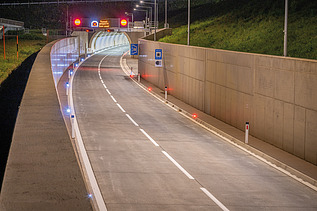
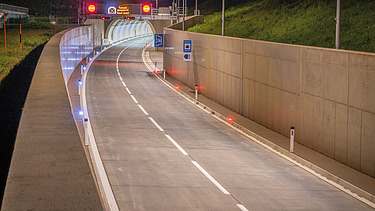
In May 2022, STRABAG Infrastructure & Safety Solutions was commissioned to provide the electromechanical equipment for the newly constructed S7 Fürstenfeld Expressway. The western section was opened to traffic on March 23, 2024. The eastern section – and thus the entire 28 km route – was officially opened to traffic on September 19, 2025.
With a total investment of approximately € 857 million, the S7 Fürstenfeld Expressway is currently the largest infrastructure project undertaken by ASFiNAG (source: Kleine Zeitung, as of March 2024). Once completed, it will span 28.4 kilometers, connecting the A2 South Motorway at the Riegersburg junction with the Austrian-Hungarian border near Heiligenkreuz.
By linking directly to the M8 freeway on Hungarian territory, the S7 makes a significant contribution to advancing European integration. At the same time, by creating a vital west-east corridor through the southeastern regions of Styria and Burgenland, the expressway plays an important role in boosting the regional economy. In addition, the construction of the S7 brings substantial traffic relief to local communities along the former main road route - most notably the towns of Fürstenfeld, Rudersdorf, and Großwilfersdorf.
Services in Detail
STRABAG Infrastructure & Safety Solutions was the general contractor for the following electrical engineering works:-
Tunnel operation, traffic infrastructure and control
- Traffic sign holder
- Traffic data collection
- Traffic control
- Tunnel and street lighting
- Tunnel ventilation system
- Doors and gates
- Environmental data collection
- Monitoring of air conditions
-
Security and communication systems
- Video surveillance
- Information transmission and processing
- Radio system
- Emergency call facilities
- Hazard alarm system
- Public address system
- Extinguishing and waste water facilities
-
Energy supply and distribution
- General electrical engineering, cabling and distribution
- Medium-voltage systems
- Transformers
- Lightning protection system
- Safety power supply
- Earthing and equipotential bonding
- CN.as line (CN.as)
- Renewable energies
-
Structural and infrastructural work
- Building and niche installation and equipment
- Free field stations
- Building ventilation and air conditioning
- Pipe and support systems
-
Maintenance
Furthermore, STRABAG Infrastructure & Safety Solutions will be responsible for the long-term maintenance of the installed electrical systems, with a service period planned for 10 years. This ongoing support ensures a reliable foundation for the safe and efficient operation of the tunnel system by ASFINAG.
-
-


-


-


Fire tests on the S7 Fürstenfeld Expressway
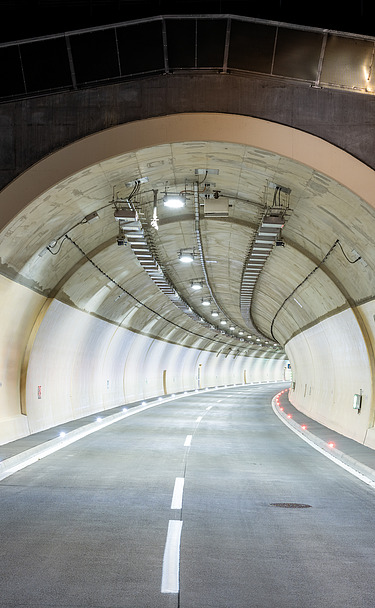
Together with SPIE Dürr Austria, STRABAG Infrastructure & Safety Solutions was commissioned to deliver the electromechanical equipment for the entire S7 route. The centerpiece of the project was the outfitting of the 2.9 km long Rudersdorf tunnel.
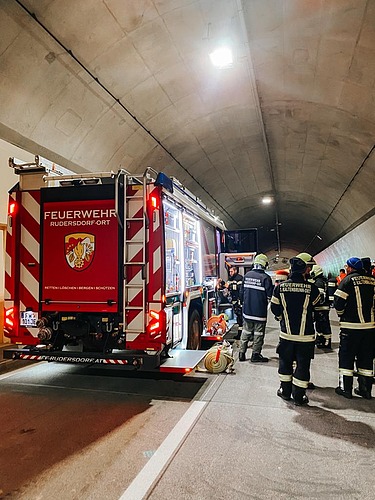
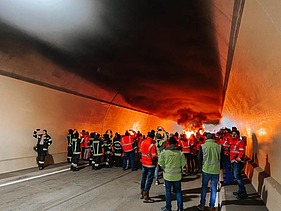
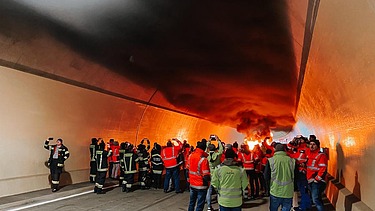
All systems and installations were thoroughly tested prior to the opening of the 14.8 km western section, which includes the Rudersdorf Tunnel, on March 23, 2024. As part of the final safety checks, STRABAG Infrastructure & Safety Solutions conducted a total of three fire tests to put the tunnel's safety systems through their paces.
During these tests, a controlled fire was ignited using two fire trays filled with a petrol-diesel mixture to simulate a vehicle fire with a fire load of 2.5 megawatts. The tunnel’s fire detection system was required to automatically identify the fire and trigger the appropriate ventilation program within 90 seconds. A key safety feature is that the smoke must be channeled along the tunnel ceiling in the direction of travel, without sinking, to prevent suffocation risks. Additional parameters, such as airflow velocity, must also be precisely regulated to maintain safe conditions inside the tunnel.
It is reassuring to see how thoroughly fire safety in tunnels is planned and tested today. Even in the case of minor incidents, the reliable functioning of all safety systems is essential. We are proud to contribute to road safety with our advanced technologies.
-
-