
Alerting Systems
Thanks to its system architecture, any network structure – from single stations to large nationwide networks – can be implemented. The alerting systems can be operated completely autonomously by using the system's own organizational channel in specially constructed distribution networks – offering excellent alerting speed tailored for these applications.
It is also possible to integrate additional transmission media or data networks, such as TETRA networks, existing directional radio links or public networks, to ensure network redundancy and enhance system reliability.
Transmission takes place according to the requirements of the organizations or terminals via POCSAG, TETRA, SDS or other technologies.

The system platform enables comprehensive implementation and also provides the required technology for siren terminals, pager systems, and fire department reporting systems. When modernizing existing networks, these are migrated into the new systems in defined phases to ensure seamless transition.
Especially for larger regional network structures, SISS alerting technology leads the way with fast and orderly decentralized alert injection into network infrastructures.
To meet the demands for data security and the associated security requirements of many authorities and organizations, various encryption methods can be integrated into the alerting systems.
Notification Systems
A clear distinction must be made between alerting – involving safety-critical aspects – and notification, which has an informational character. For the transmission of notifications and information by authorities and organizations, a variety of communication channels such as mobile networks, email, or landline telephony can be used.

The management of these transmission media within the control center is enabled by SISS applications. These include user interfaces as well as mechanisms for generating alarm and pre-recorded voice messages, dynamically forming alarm groups, evaluating feedback, or initiating escalation measures through additional alarm groups.
System Overview
The alerting system consists of an alerting network built with Digital Alarm Repeaters (DAU – Slaves) and a central alert-triggering unit (Control Center).
Input into the alerting network is primarily provided by the redundantly configured Master Digital Alarm Repeater (MDAU for short) at the alert-triggering unit. These are controlled by the also redundantly configured Digital Alarm Devices Type III (DAGIII for short). Using the DAGIII, alarms can be injected into the alerting network, immediate alarm transmission confirmations can be received and evaluated and monitoring and configuration actions for the alerting network can be carried out.
As a supplement, or in the event of a control center failure, alarms can also be injected into the network via mobile emergency alerting units. In this case, a laptop serves as a remote mobile DAGIII, which can be connected to any digital alarm repeater in the network. Alternatively, a dedicated mobile master digital alarm repeater can be used instead. In all cases, the full functionality of the alerting components at the control center can be replicated, including the CAD interface. Furthermore, with the appropriate connection to the control center, alarms can also be transmitted by a remote mobile DAGIII via the control center’s MDAUs.
Additionally, as a backup or supplement to the control center, decentralized input stations equipped with the core alerting technology – consisting of both – can be set up. This enables system-wide alerting and allows network status monitoring.
Detailed System Overview of the AIS3020
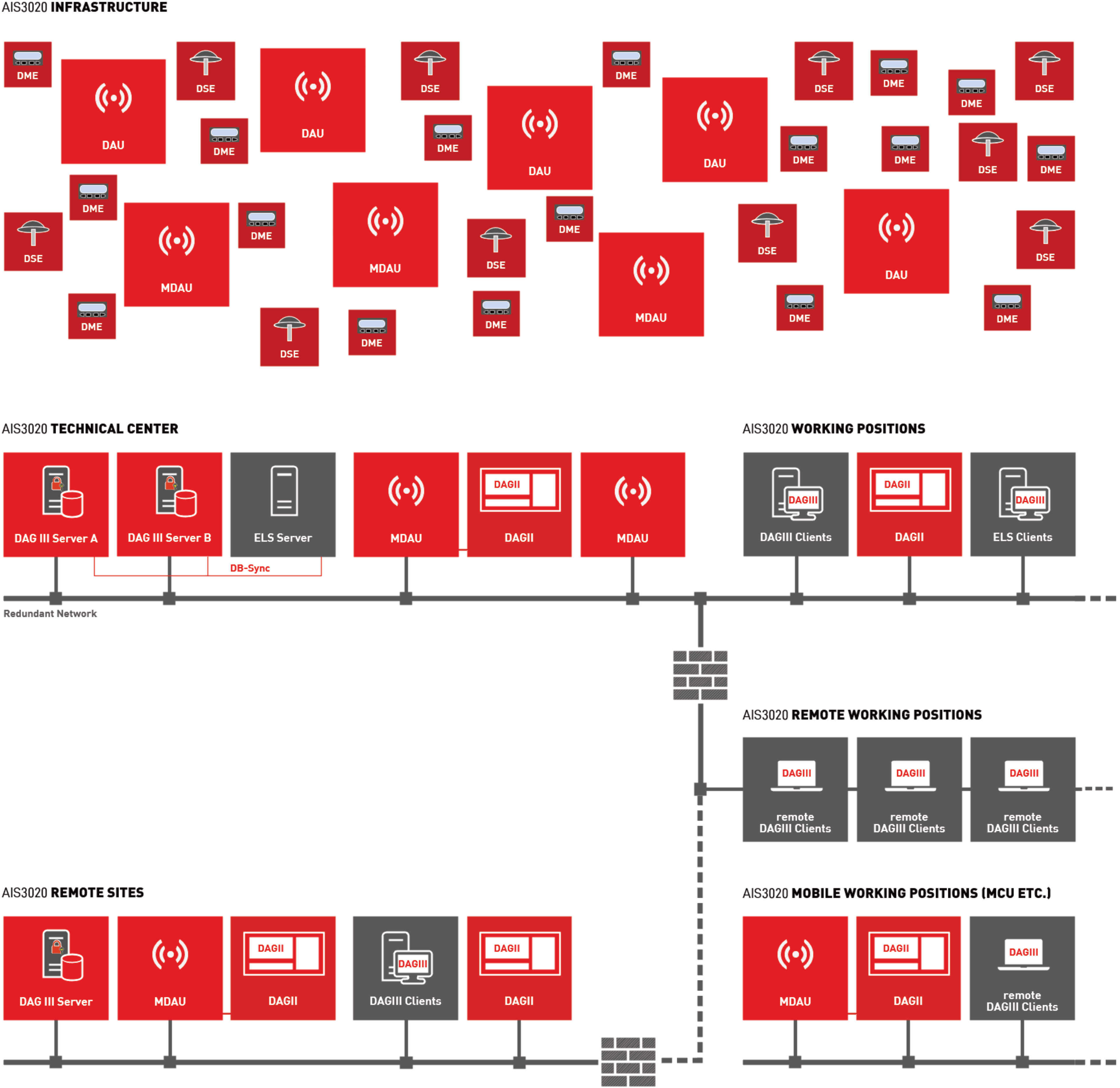
System overview AIS3020
Key Features
- Outstanding alerting performance through intelligent and dynamic routing of alert sequences and a dedicated organizational channel
- Regional customization of alerting
- Secure encryption methods and comprehensive network protection against sabotage
- Reliable redundancies
- Flexible and expandable alarm devices
- Remote workstations for command vehicles, fire brigade operations centers or situation and staff rooms – optionally with a dedicated master alarm repeater
- Comprehensive system and network monitoring with intuitive user interface
- System updates and functional adjustments possible during ongoing operation