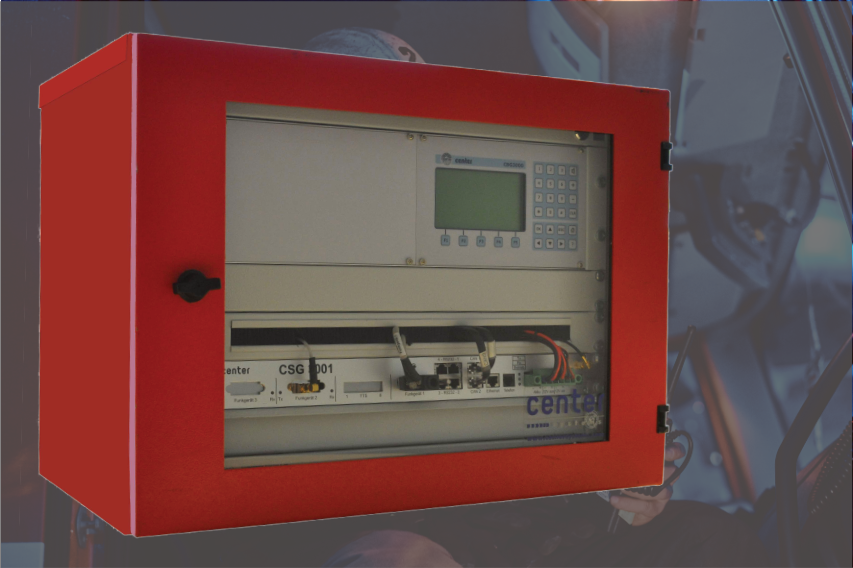
CSG3020 - the basis for a wide range of possible uses
As a 19" module, the CSG3020 is the universal and flexible platform for analog and digital alerting systems. Backwards compatibility means that the CSG3020 can also be used for existing systems.
The variety of interfaces and the reliable and comprehensive functions allow it to be used in local or large-scale alarm and information systems for BOS and industry.

-
Powerful Processor and Sub-Processor
All functions are controlled by a powerful processor; a dedicated, high-performance subprocessor is available for real-time tasks - data transmission, synchronous POCSAG transmission and time synchronization.
-
Time Synchronization
The integrated GNSS module enables high-precision internal time synchronization and correction of the integrated, oven-stabilized, high-precision oscillator. This means that GNSS downtimes of several hours can be bridged.
-
Fast Data Transmission
A 4L FSK data modem enables fast data transmission via radio at up to 9600 baud. The hardware is designed to enable alternative time synchronization via radio with reduced accuracy.
-
Radio Interfaces
Two radio interfaces allow simultaneous data and POCSAG operation, and voice transmission is also supported. The connection of redundant or dedicated transmission media, such as TETRA-FRTs or mobile radio modems, is provided.
-
Network Connection
Different Ethernet networks can be connected via the two network interfaces and routing is optionally supported. Fail-safe operation can be increased with the bonding mode of the interfaces.
-
Digital Inputs and Outputs
8 relay outputs, 7 digital inputs and a fire alarm input with integrated loop monitoring allow a wide range of special functions. Additional function modules - e.g. I/O extensions - can be connected and operated via a CAN interface.
-
Emergency Power Supply
A 2 A charger for lead-acid and lead-gel batteries is integrated for the emergency power supply. Fast charging can be carried out using an external power supply unit with max. 15 A.
-
Bidirectional Data Exchange
Depending on the network structure and requirements, extensive system and feedback information is made available to the central entry points and control centers.
-