Service & Maintenance

Long lifecycle of systems through professional maintenance
Safety on roads and in tunnels depends not only on modern technology – but also on how well that technology is maintained. With a professional maintenance strategy, we extend the lifecycle of your systems and ensure their functionality for many years to come.
The implementation of our maintenance strategy is based on cost-optimized execution of servicing and inspections, fault and damage repairs as well as continuous system improvements – all aligned with the specific objectives set by our clients.
In addition to a trusting collaboration with our clients, our many years of experience in tunnel and traffic solutions are essential for achieving a wide range of goals. We understand our customers’ needs and support them with our expertise every step of the way.
-
-
Ongoing training and education of our personnel ensures that, in the event of a fault or damage, we can respond quickly and efficiently to restore functionality as soon as possible.
Over time, our Service and Maintenance department has evolved from a traditional maintenance crew into a group of specialists in a wide range of technologies – including hydrant testing, lighting measurements, UPS systems, sensor and measurement technology, software development, and much more. This broad expertise ensures smooth and safe traffic flow at all times.
Our service portfolio at a glance
- 24/7 phone support & on-call service (electrical engineering, software)
- Maintenance, inspection & fault repair
- Damage service & warranty handling
- Spare parts packages
- Hydrant testing
- Electrical safety inspections
- Lighting measurements
- IT security (e.g. NIS directive)
- Handling of small-scale projects
- Optimization & improvement, upgrades & updates
- Training & education
The four areas of maintenance
We see ourselves as a service department whose aim is to carefully identify and comprehensively fulfill customer needs. Customer satisfaction is the foundation for long-term collaboration and is therefore essential for the successful implementation of our maintenance strategy for your technical infrastructure. This strategy includes the following four areas:

Maintenance
The aim of maintenance is to preserve the current condition of your (electro)technical systems – thereby delaying the need for repairs as long as possible. The term maintenance therefore covers all measures to delay the wear and tear of a system. This includes cleaning, lubrication, calibration and the replacement of auxiliary materials. Maintenance is carried out at regular intervals – either according to the manufacturer's specifications or based on an individual operational strategy.

Inspection
Inspections are conducted to assess the condition of technical systems and installations, with the aim of detecting potential faults or weaknesses at an early stage. Common inspection measures include visual checks for damage, functional tests and measurements. Like maintenance, inspections should also be performed at regular intervals.
Repair (Corrective Maintenance)
Repair includes all actions taken to eliminate damage to electrical or mechanical systems that may impair their functionality. This can involve the repair or replacement of individual components or assemblies, up to and including the replacement of entire systems.
Continuous improvement
The final part of the maintenance cycle focuses on continuous improvement. This is not about repair, but rather the combination of technical and administrative actions, as well as management decisions, aimed at enhancing the reliability, maintainability, or safety of a system – without altering its original function. If an improvement opportunity is identified, it is presented to the client and further steps are coordinated accordingly.
The definition of maintenance
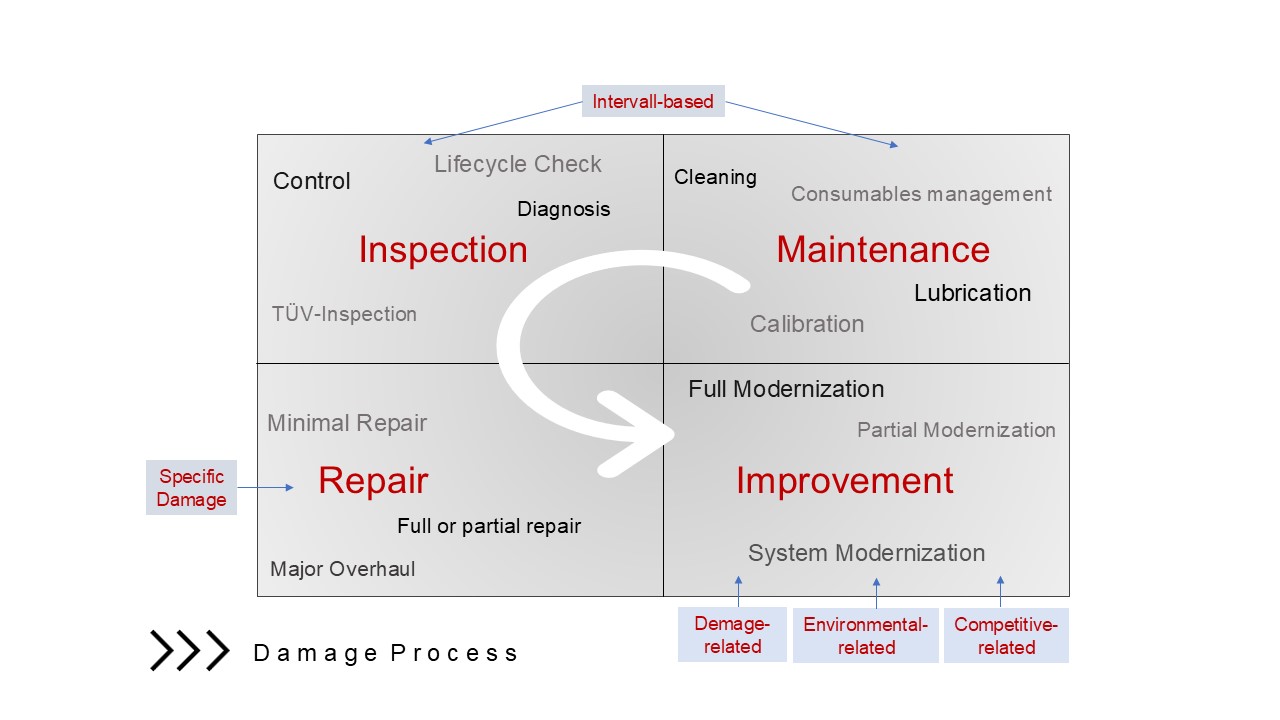
Definition of maintenance